Liminal Space
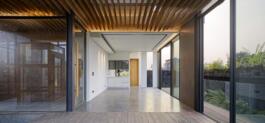
The Liminal Space exhibition serves as a profound manifesto, reflecting on the two-decade architectural journey of Budi Pradono.
This voyage began in 2005 when, after traveling the globe, he returned to Indonesia to reignite his creative practice through an inaugural exhibition titled Secondary Skin. This momentum was carried forward through subsequent exhibitions such as 20.10.2010 and In Process. As his architectural discourse evolved, his works have been showcased in prominent venues and cities worldwide, including the Frangipani exhibition in Sweden, the Venice Architecture Biennale, London Design Festival, London Design Week, Milan Design Week, Tokyo, and New York.

Towards an Anti-Object Architecture Since the advent of modernism, urban development has been continuously defined by a struggle with formal geometry—whether cubic, rectangular, or circular. This tradition persisted through the postmodern era and was later critically interrogated during the deconstructivist phase. However, in the post-pandemic context, my personal reflection on the true essence of architecture has gravitated toward the philosophy of Anti-Object Architecture.
This approach deliberately steps away from conventional debates over physical form and geometric dominance. Instead, it prioritizes the cultivation of atmosphere, realized through highly intentional materiality, nuanced lighting, and ethereal spatial relationships. Within the paradigm of Anti-Object Architecture, a building is conceived to harmonize seamlessly with its natural environment—often appearing seamlessly integrated, or even "buried" within the broader contemporary landscape. Architecture no longer asserts itself as a dominating object; rather, it manifests as a spatial experience that invites humanity and nature to coexist simultaneously.


Liminal Space (The Bamboo Dome) Serving as the concrete embodiment of the Anti-Object Architecture philosophy, this dome-shaped installation in Summarecon Bandung represents the concept of a journey. Built entirely from bamboo treated with a burning technique inspired by the Japanese shou sugi ban, the structure is not merely a physical enclosure, but a phenomenological medium meant to be interpreted personally by each visitor.
The spatial experience begins with a procession that draws visitors from the exterior down into a subterranean realm. Inside, Budi Pradono collaborates with street artist Farhan Siki to create a deeply atmospheric environment. Rainwater drips onto metal and wood within the dimly lit space, creating an ambiguous atmosphere defined by water, darkness, and guided vertical transition.
Ultimately, Anti-Object Architecture offers a profound alternative: an architecture that no longer speaks solely of form, but of presence, atmosphere, and the intricate, lingering connections between humanity, material, light, and nature.


Anti Object Architecture Exhibition
Dancing Hotel Situated within the historical context of a 1930s colonial neighborhood—an area traditionally dominated by symmetrical Indische architecture with classic gable roofs and front verandas—the Dancing Hotel emerges as a bold intervention. It redefines its context by deconstructing the facade, utilizing exposed concrete walls whose dynamic articulation reinterprets the rhythmic movements of the traditional Jaipong dance.
The elongated mass of the building is deliberately bifurcated, with a Pulai tree planted in the center serving as both a divider and a unifier of the two volumes. Challenging the rigid symmetry of its colonial neighbors, the parallelogram-shaped glass windows lean assertively to the left and right. This radical approach to form is paired with a highly responsive climate strategy: the split mass allows continuous cross-ventilation from front to back, establishing a new architectural identity while respecting environmental sensibilities.


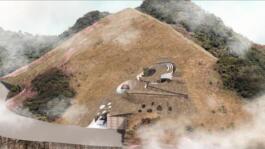
O Hotel Perched on the ridges of Mount Salak, the O Hotel deliberately induces a sense of alienation within its natural context, appearing almost like an otherworldly vessel that has quietly landed on the slopes. Its stark, circular geometry creates a profound contrast with the organic landscape, yet this very tension fosters a compelling dialogue with both the internal void and the surrounding mountains.
At the center of this void lies a tranquil water feature, while the rooftop features a jogging track that offers the surreal experience of "running above the clouds." The hotel rooms are arranged in clusters, connected by corridors of varying dimensions that seamlessly transform into vibrant, dynamic public spaces. Locavore “Nature occupies architecture; nature takes over architecture.” The architecture of Locavore is conceived as an integral topography, a modern spatial interpretation of traditional Balinese rice terraces. The structure responds to the adjacent rice paddies by acting as a grand natural courtyard. From the exterior, its articulated form mimics a mountainous hill, while the internal landscape serves as a direct mirror of the exterior terracing.

An active green roof, cultivated with edible plants, redefines the narrative of a traditional restaurant, catering to modern individuals who are increasingly mindful of the provenance and preparation of their food. The circulation path is designed as a culinary procession—much like a multi-course meal—where every level reveals varying depths, spatial surprises, shifting materials, courtyards, and lush woodland.
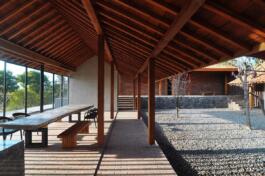
Bp Gallery is defined by a dialogue of calm tension between two distinctly contrasting masses. The first volume is a traditional Javanese Joglo supported by 16 wooden columns. While such ancestral structures are conventionally grounded by heavy stone bases (umpak), here, that permanence is questioned: the entire structure is elevated on slender steel supports, rendering the heavy wooden columns seemingly weightless and floating.
The second mass is a windowless, monolithic circular volume crafted from rammed earth—dense, heavy, and timeless. These two opposing forces are simultaneously connected and separated by a sharply slanted wall that shatters the traditional Javanese spatial hierarchy while providing access to the monolithic gallery's interior. A piercing architectural line successfully materializes the dialogue between the open, floating heritage structure and the closed, grounded monolith.

Omah Tanah House Boty Awards
A project designed by Budi Pradono Architects, nominated for ArchDaily’s Building of the
Year 2026
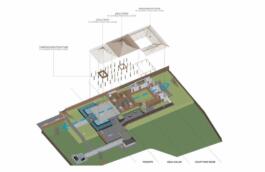
Omah Tanah House stands as a quiet exploration of architecture that grows from the ground it inhabits. Conceived through an extensive process of research, experimentation, and material investigation, the project reflects a deep commitment to building with the earth both literally and philosophically.

Omah Tanah House stands as a quiet exploration of architecture that grows from the ground it inhabits. Conceived through an extensive process of research, experimentation, and material investigation, the project reflects a deep commitment to building with the earth both literally and philosophically.
Located near Lodji Beach in Pelabuhan Ratu, West Java, the house embraces its surrounding landscape through a spatial composition of courtyards, open volumes, and a transparent roof that invites light while harnessing solar energy. It is an architecture that breathes with its environment, responding to climate, context, and the rhythms of nature.
The nomination for ArchDaily’s Building of the Year 2026 marks not only a milestone for the project, but also a recognition of a broader architectural intention: to create spaces that are grounded in local wisdom, shaped by collective effort, and sustained by an awareness of their environmental impact.
More than a singular work, Omah Tanah House represents a continuous inquiry into how architecture can emerge from its place honest in material, sensitive in presence, and enduring in meaning.


Omah Tanah: Celebrating the Dialogue Between Humans, Nature, and Time
A book by Budi Pradono reflecting on an architectural journey based on material wisdom,
local culture and sustainability, officially launched at Art Jakarta on 4 October 2025

Omah Tanah is born of contemplation about place and the life that grows upon it. It is not just a house; it is a statement on how architecture can be grounded in the earth and exist in harmony with nature.
Through exploring rammed earth walls in combination with the unique architecture of the Indonesian archipelago, the book demonstrates how buildings can become an extension of the landscape, absorbing light, accommodating wind and respecting the long-standing traditions of the area.

A journey across countries, from China to Indonesia, is captured within its pages. Material experimentation blends with sustainability and social awareness to present reflections on the meaning of building in the modern era.
More than mere documentation, Omah Tanah reminds us that true architecture is born not from ambition, but from a gentle dialogue between humans, nature and time. It is a conversation that continues to evolve, just as the earth returns to being a home for life.


Plaza Timbulun: A Flowing Space, a Living Space
2023


This waterfall stretches from Kerinci Seblat National Park to Painan Bay—a hidden treasure in West Sumatra. Formerly private land has been transformed into a public space, a plaza where everyone can experience the natural beauty of Painan.
Our architectural approach is based on the geographical character and the local socio-cultural pulse. We believe that the true power of a place lies in its identity. By listening to the landscape and understanding traditions, architecture can create spaces that are not simply containers, but reflections of their communities. This creates opportunities to advance local identity, open new perspectives, and provide authentic experiences for all.

INAGRO Nusantara Flora and Fauna
Conservation Project
2024 -

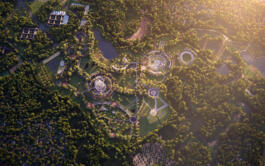
Nestled in the verdant landscapes of Bogor, the Inagro Nusantara Flora and Fauna Conservation Project redefines conservation tourism in Indonesia. This visionary initiative transforms a naturally rich habitat into a premier destination dedicated to preserving and showcasing Indonesia’s unique endemic species, offering an immersive blend of education, sustainability, and cultural heritage.
The project’s design is a striking fusion of modern architecture and environmental harmony. Bold geometric structures create a visually captivating identity, seamlessly integrated with Bogor’s lush surroundings.
The landscape design draws inspiration from the Wallace Line, thoughtfully organizing flora and fauna into distinct Asian and Australian zones. This innovative zoning not only educates visitors about Indonesia’s biodiversity but also fosters a deeper connection to the natural world.
The materiality and design language of the project emphasize a fusion between modern and traditional elements. In addition to contemporary architecture, the project also features follies or supporting structures that serve as fatigue points (resting areas) for visitors. These elements are inspired by details from traditional Indonesian vernacular houses, adding a rich cultural layer to the modern design.
At the heart of the project lies a state-of-the-art aviary, serving as a central hub that unifies the various zones. Sustainable landscape management ensures the preservation of the ecosystem while prioritizing animal welfare, creating a thriving environment for both wildlife and visitors.
Blending contemporary innovation with cultural reverence, the project incorporates traditional Indonesian architectural elements. Follies, inspired by vernacular houses, serve as inviting rest areas, enriching the visitor experience with a nod to Indonesia’s heritage. This harmonious interplay of modern and traditional design sets the project apart as a cultural and ecological landmark.
As Indonesia’s first conservation-focused initiative dedicated exclusively to endemic flora and fauna, the Inagro Nusantara Flora and Fauna Conservation Project is poised to become an iconic symbol of sustainability and biodiversity. It invites visitors to explore, learn, and connect with the natural and cultural treasures of the archipelago in an unforgettable way.

Budi Pradono Won a Major Award in IAI Jakarta Awards 2024 at Category of Private Residential Building on A Large Scale: Omah Djawa, Wonosegoro


This house is located in the Wonosegoro village, it is about one hour drive from Semarang, Central Java. This place is far from the hustle and bustle of the city with wide rice fields, tropical forests and with beautiful and friendly people.
The architectural and interior concept is a reinterpretation of a Javanese house where all spaces are arranged based on a datum line where the spaces are interconnected but at the same time have their own privacy. In Javanese tradition, the house is a representation of nature so that this closeness to nature is indicated by the quality of open, semi-closed, and closed spaces, all of which are sequentially related. So entering these gardens before entering this house is an experience of space and appreciation of gardens with wild and neat Javanese characters at the same time.

The main basic strategy is to create a system in managing the landscape by making various qualities of space with terraced levels so that at one point the level provides a more complete view of the environment. The quality of this landscape is an attempt to bring calm spaces and have character to each of them. In the front area is the Pendopo house (as the reception lounge), which is an open space with a size of 11 x 11 meters. It is an ancient building that has been reconstructed. This wooden building is more than 60 years old. Apart from having historical value, this Pendopo has also survived several earthquakes.


The interiority of the interior space is a unity with all materials, with a straightforward and unpretentious material language that only combines teak wood, red bricks produced by the local community, metal and river stone to provide new value and is a reinterpretation of the Javanese building concept with a modern space program so that this house is very comfortable to live in or to work from home program during the pandemic.
On the layer behind the pavilion there is an omah dalem (inner house) which consists of a structure similar to a Joglo shape but is provided with local brick walls and wooden windows. And divided into four bedrooms. Then behind it, there is a courtyard with other rooms around it. The courtyard is given a Javanese sapodilla plums plant as a symbol that the owner will share kindness with everyone. The spaces between the courtyard are the terrace, three bedrooms, and one main dining room.
Affinity House by Budipradono Architects Won a 3rd Place in Daikin Designer Awards 2024


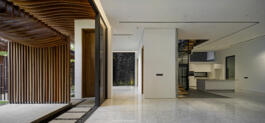
Affinity house is a project designed during the pandemic in 2021, when conditions in Jakarta were less conductive. Therefore, we proposed to create a large area of prayer room with the stairs and elevator as the main program at the center of the house which becomes the datum that orchestrating all functional programs inside the house. In addition, the building is made like an island that is detached from neighbor wall in order to have good air circulation.
The material selection is focused on providing a calming ambiance to the owner after going through a long daily process after work. Therefore, most of the materials are chosen are representing the natural elements. The perimeter of the building is made from natural stone with the touch of vegetation and the bale-bale and rooftop is using wood elements. An urban courtyard was created on the back side of the house allowing the building to breathe well with the addition of tall growing tree of fosil tabebuya that can be enjoyed from the bathroom and walking closet.
V-Tower on London Design Festival 2023 : Metaverse Architecture and Game
Architecture's Response to Nature Colonization

We recognize that nature is colonizing and changes are inextricably linked to social, political, and economic forces due to the fact that the climate is altering concurrently with the colonization of the planet by nature. This change has been going on for a long time since the advent of industrial modernity which was formed because of the capitalist economic system, the right to freedom they have in managing their capital assets and the natural resources they own, on the other hand, has brought about various environmental crises. In actuality, the devastation of our environment by deforestation, anthropogenic pollution, and forest fires has driven us into catastrophic circumstances, with the threat of extreme temperature rises, massive flooding and declining agricultural yields looming ever larger over humankind. Now, the primary concern is what we can do to deal with the situation.
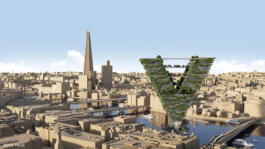
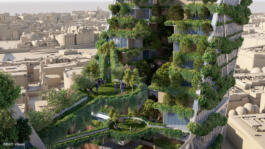
V-Tower was designed by Budi Pradono Architects to demonstrate how architecture can adapt to environmental change. The V Tower, situated in the midst of the Thames River and the city of London, is a site where nature is being decolonized. It provides an ecosystem in which humans and nature coexist harmoniously. Through parametric green façade as secondary skin, the structure was designed to allow nature to thrive and react to the climatic conditions. The negative space between the letter 'V' provides abundant light to penetrate the tower and transparency to the city. Combined with the green space terrace and bridge that connected the tower bulk, the tower became the epicenter of cooling the dense city of London.
V-Tower Game provides a new way to experience architectural spaces beyond space and time through a collaboration with Festivo, an Indonesian VR company. This hybrid reality is part of a larger plan to create a visual and human-perspective-based experiential zone.
A user's comprehensive gaming experience will be rich in exploration, imagination, and innovation, and will enhance their overall experience. In the V-Tower Game, there is no limit to how far users can investigate; the game's architecture merely guides players through the space. Here, the distinction between the real, the potentially real, and the 'imaginary' begins to dissolve. The outcome is immersive, interactive, and captivating.

Architect BUDI PRADONO Architect Firm BUDI PRADONO ARCHITECTS Design Development Stage BUDI PRADONO, HAFIDZAH MAHESWARI, RENDY FITRANANDA, AGRAPRANA Image Rendering DXD VISUAL Film Director&Animation BAGUS PRADONO Animation Support Team HAFIDZAH MAHESWARI,ALDI FANSYURI, DISSYA ARLEINI Game Developer Company FESTIVO Writer&Creative Director FITRAH HARDIGALUH Junior Art Director&UI Designer CHELSEA 3D Artist&Animator SAMUEL CHRISTIAN Technical Manager MUHAMMAD ARI KURNIAWAN Game Developer JONATHAN FRANZELI
Budi Pradono Won a 3rd Place in a National Competition: Vice Presidential Palace of Indonesia


Dwi Arya Wibawa is a symbol of authority and influence of the vice president that governs Indonesia with his breakthrough regulations and actions. The palace of this second in command of Indonesia’s executive government that leads the country in all honesty and loyalty is designed to be a landmark that allows its people to come and see how a presidential office works. The purpose of this design is to cut the distance between government and the people and become a celebration of democracy that has been stated in Pancasila without degrading the security and prestige of a presidential office.
Budi Pradono NFT


Budi Pradono Architects is determined to locate you to Mars !
In response to challenges faced by environmental change and modern lifestyles, our NFT Launch focuses on the future of visionary cities, public buildings, cultural buildings and private housings.
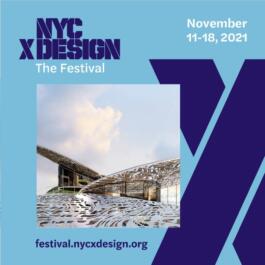
A post-pandemic project that proposes a new way of living; launched during NYC X DESIGN in 2021 and now as a collection of NFTs:
A middle-class Musk House villa in Mars
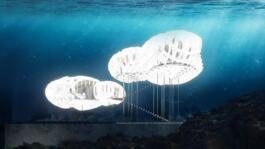
An underwater living in Cloudy House
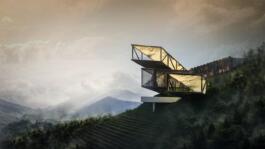
And Stellar House and V House located in a wild nature setting.
Our launch kicks off with the Musk House on 22.02.2022 and will go on until we reach an end goal of 2022 NFTs.
This is the start of a platform for artists to share, create and be connected within an ecosystem - the start of a visionary metaverse city to socialize in our virtual experience in an immersive way on the blockchain.
https://opensea.io/budipradono_nft
budi pradono architects / ESCAPE 0.2 : post pandemic a new way of living space
https://festival.nycxdesign.org/event/escape/


budipradono architects is a research-based architecture & urbanism studio focusing on contemporary lifestyle, hospitality and urban design. with in-depth research as the basis of each of our design, we always respond to any changes that occur in nature and life into our architecture.
ESCAPE 0.2 by budi pradono
Our research is about understanding the post pandemic living space which has impacted the change of human in relationship with nature. As our digital society living on new digital life, we found the new possibility to create a new digital house. A new way of living that has a big impact on spaces as a response of human daily activities, the sensitivity of the human body to the quality of the nature, air circulation, space, & lighting.
“The pandemic has brought home the way in which our living environments can be disrupted,”
In this 2021 NYCxDESIGN we developed four houses as translation of this new way of living in our post-pandemic digital society
The Musk House
Cloudy House
V House
Stellar House


budipradono architects is a research based architectural studio focusing on contemporary lifestyle, hospitality and urban design.
budipradono architects
JL.Walet 6 blok I.2 no 11
Sector 2, Bintaro Jaya,
Jakarta Selatan 12330
Indonesia
(021) 7370367
info@budipradono.com